Counter-Archives and Public Memory (Kiiru)
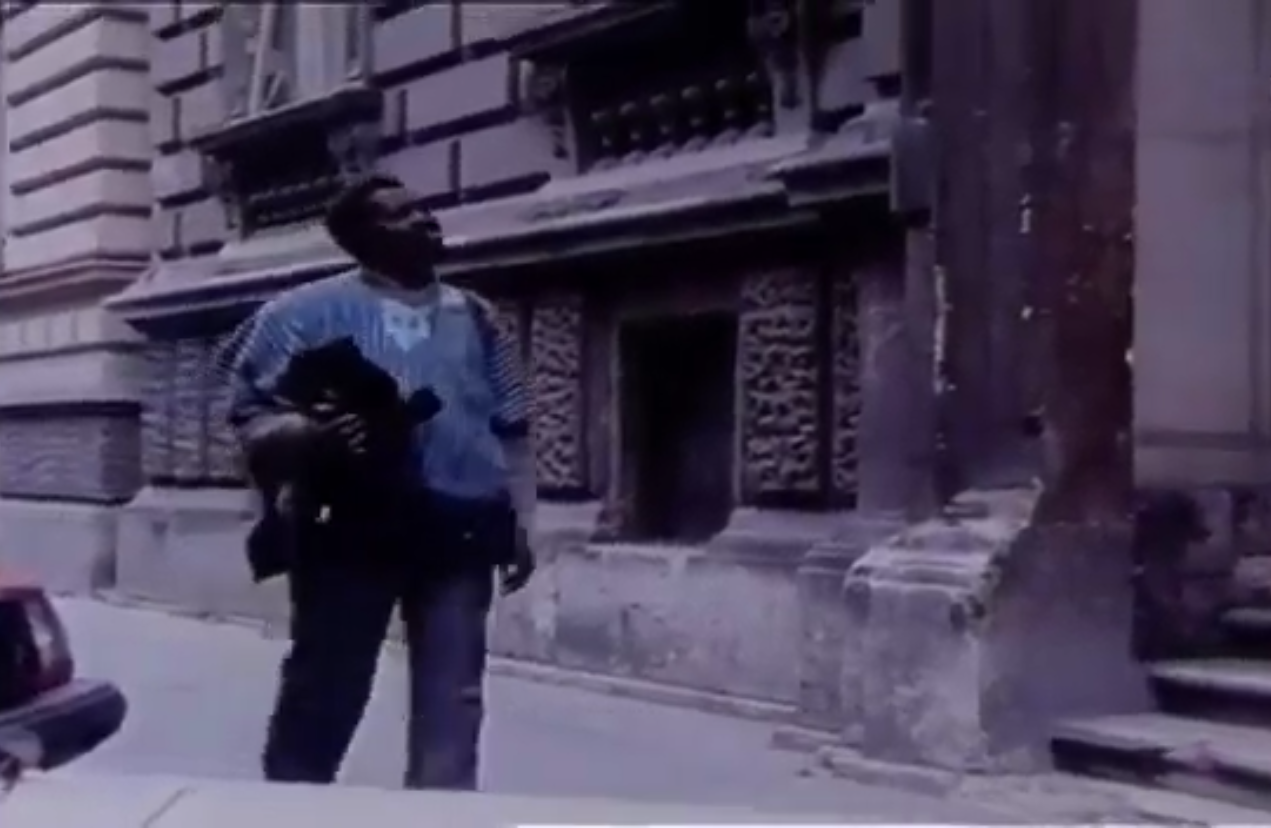
Lawrence Kiiru does not enter this project as a commentator from the outside. He enters as someone who has already been negotiating the archive from within it. His life stretches across Kenya, Yugoslavia, Croatia, Paris; his work moves between theatre, documentary, literature, and memory. In him, diaspora is not a theory. It is lived consequence.
Kiiru—Independent filmmaker and theatre director whose work intersects with Lerman’s legacy and the region’s African connections–widens the aperture. When Kiiru speaks about identity, he does not do so abstractly. He describes leaving Kenya and only then fully understanding what it means to be a Black man. Distance clarified the social architecture of race. In his words, it is “after you leave your country and sit somewhere outside for a long time” that identity becomes unavoidable. Europe did not introduce him to Africa; it sharpened it. The encounter with difference produced recognition.
This sharpening informs his artistic practice. His play Black and White Is My Colour was not created for African audiences. It was staged for Croatians. Drawing inspiration from Jean Genet’s The Blacks, Kiiru and his collaborator explored how Blackness is constructed through white imagination — how one is often forced to perform what others already believe about you. The production did not seek affirmation. It sought friction. It asked its audience to confront the instability of the categories they inhabit.
That gesture alone situates Kiiru as a builder of counter-archives. He does not merely retrieve forgotten histories; he re-stages the conditions under which those histories are misread.
This becomes particularly visible in his early documentary on a Croatian explorer who traveled to the Belgian Congo. In Osijek, the explorer is commemorated with a street name and civic pride. The local archive presents him as adventurous, ambitious, emblematic of national presence abroad. Yet Kiiru recalls discovering troubling dimensions of the Belgian Congo during his research — dimensions that complicated the celebratory narrative. As a young filmmaker, he included what he could but did not push as far as he now believes he should have. He admits that today he would return to Congo, investigate more deeply, interrogate the explorer’s service to the Belgian king, and ask what his role meant within the machinery of colonial violence.
'Lerman' film by Lawrence Kiiru (1988)
What is striking here is not confession. It is structural clarity. Kiiru’s reflection reveals that the archive is not neutral terrain; it is shaped by reputation, by municipal pride, by what a community is willing to confront about itself. His hesitation as a young filmmaker mirrors institutional hesitation. The story of the Congo could not be pursued without destabilizing the local hero. The archive held both evidence and restraint.
In this sense, Kiiru embodies the contested archive. He is simultaneously insider and outsider — Kenyan by birth, shaped by the Mau Mau era and the detention of his father, yet educated within Yugoslav non-alignment and embedded in Croatian cultural life. His films move through Croatian memory while carrying African political residue. He understands commemoration from within, and therefore he sees where it closes.
His personal history complicates any simple notion of return. His daughter, born in Croatia, educated in Paris, now lives and works in Kenya in ethnomusicology and traditional dance. Movement circulates. Africa is not a distant origin but an active axis in his family’s present. When asked what return means, he recalls his grandmother telling him to “go out there, meet the white people, and come back.” He laughs at the irony, yet his answer reveals something deeper: he discovered Africa within Europe. Return, for him, is not only geographic. It is an internal excavation.
For Ukubuyiswa, Kiiru’s presence widens the aperture. He demonstrates that institutional narration is never total because it is always intersected by lived experience that exceeds it. Croatian commemoration of explorers does not erase colonial entanglement; it merely stages one version of it. African identity in Europe is not silent; it finds form in theatre, in documentary, in adaptation of Ngũgĩ wa Thiong’o, in conversations that refuse to collapse into comfort.
Kiiru does not dismantle the museum from the outside. He complicates it from within the cultural field it inhabits. He shows that counter-archives are already in motion — in performance spaces, in film grants, in the hesitation of a young director who senses the weight of what cannot yet be fully spoken.
Through him, we see that public memory is porous. It can be widened. It can be questioned. It can be made to hold more than its official plaques suggest.
In conversation with filmmaker and theatre director Lawrence Kiiru as he reflects on identity, memory, and the complexities of making African histories visible within European cultural institutions.