On Return, Method, and Relational Care
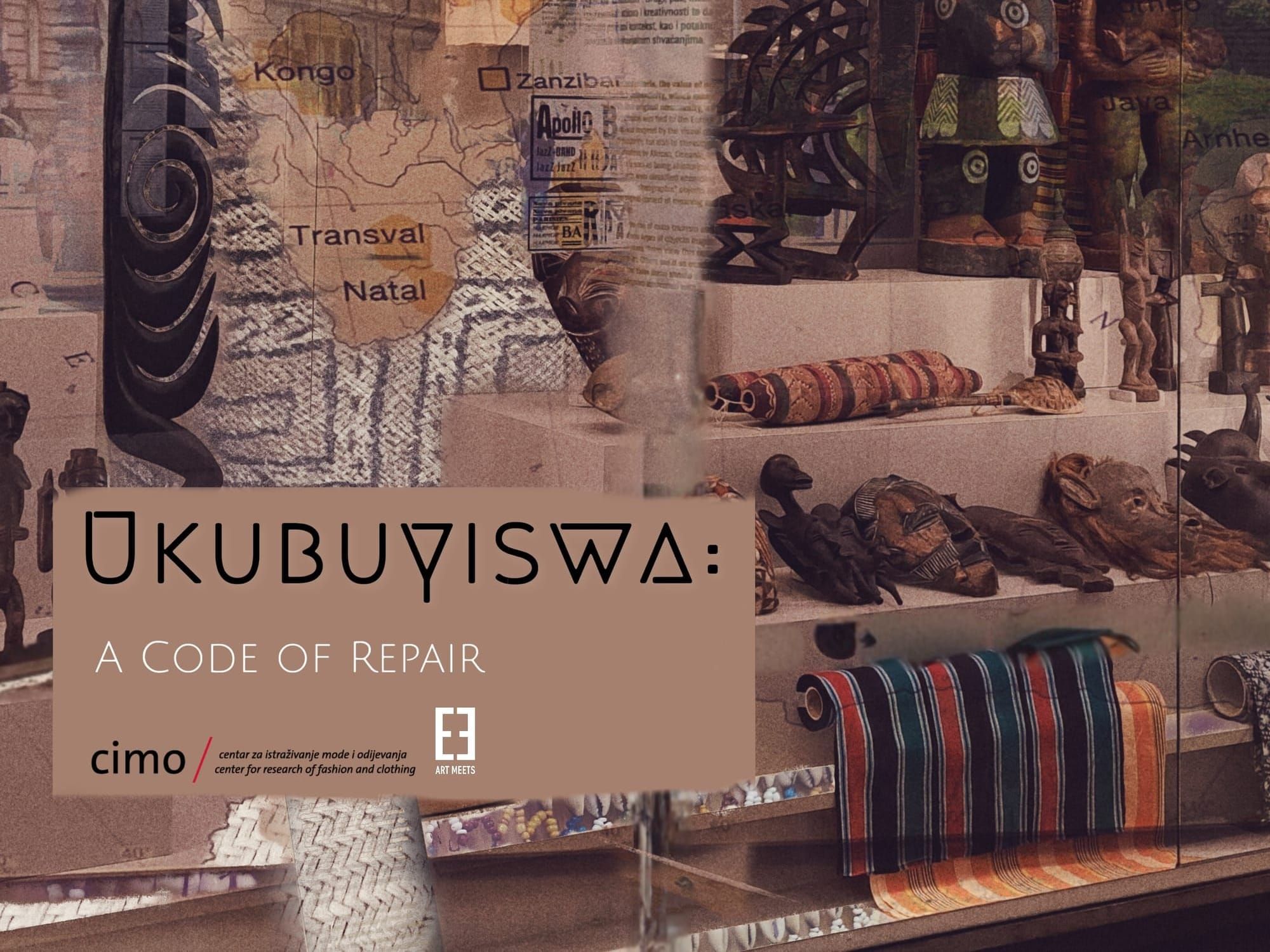
Ukubuyiswa could be described as a project concerned with return. Yet return, in this context, is not a singular event. It is not confined to the movement of objects across borders. Return names a reorientation — a turning toward histories that have been obscured, relationships that have been strained, and narratives that have hardened into certainty.
To speak of return without speaking of method would be naïve. The way one approaches the archive, the museum, the collaborator, the co-researcher — these approaches determine whether return becomes restoration or repetition. Method, here, is not technical procedure. It is ethical positioning. It is the question of how knowledge is gathered, who is invited into its shaping, and what forms of refusal are honoured along the way.
Relational care and consent are not appendices to this process. They are conditions of possibility. In a field shaped by extraction and asymmetry, care becomes a corrective practice. Consent becomes structural rather than symbolic. Without them, return risks becoming another gesture enacted upon rather than with.
The sections that follow are not separate reflections. They articulate a shared foundation. Together, they outline the commitments that shape Ukubuyiswa’s approach to research, collaboration, and public memory.
On Return
What do we mean when we speak of ukubuyisa? Sithi sibuyisa ntoni? Njani?
What relations are being re-entered, and through which acts? Who is invited into this process, and who authorises its terms? Does return stand alone, or are there preceding obligations that must first be fulfilled in order for return to be possible at all? What are we, as those initiating ukubuyisa, asking of the one who is being returned, or who is returning?
Ukubuyisa becomes a working method: a ritual practice through which what has been taken is re-presenced through relation, rite, and repair.
When we speak of return ngesilungu (in the colonial), what are we instituting? What, exactly, is being set into motion, and by whom? Which procedures guide the act, and which relations are rendered invisible in the process? Dictionaries define “return” as the act of going back, or sending something back to a place or person. They do not name the conditions that make return reciprocal, relational, or reparative.
Ukubuyis(w)a approaches restitution not as a single event in which things are handed over, but as a set of concurrent actions unfolding in phases without a fixed end. We attend to rituals of return while grappling with institutional procedures and methods of material preservation and care, gathering reflections from co-researchers and community contributors. Our multidisciplinary approach invites forgotten histories, voices, and practices into the act of restitution, reconstituting ancestral knowledges and experiences, while rehabilitating cultural belongings and the sites that have long held them in stasis.
We centre cultural belongings (not “objects”), Ancestors, and vessels—consecrated carriers of presence. Through this research project, we work within isiXhosa theology to rehabilitate space and restore dignity to museum-held belongings, approaching them as relations-in-care rather than objects of study.
On Method
… something is being remembered.
“…eli eliphambili kweli kokubuyisa, kukukhapha.”
A pause.
“It is a continuation of something.”
Another pause.
“Ukubuyisa is a continuation for ukukhapha.”
Then he asks—almost as if turning the question back to us:
Now uyabuza kum: what do people do xa bensenza lonto leyo, through all the stages efuna ziqhutywe?
What happens when time has passed? When the person was escorted long ago, ekhatshiwe—and yet something remains unfinished?
What must be done then? Prof. Ncedile Saule (30 September 2025, 21:08 pm)
Here, sequence becomes unavoidable: ukukhapha precedes ukubuyisa; the latter continues the former rather than standing alone.
This becomes a methodological spine for the project:
(a) do not isolate acts of return from the rites that make them safe and intelligible;
(b) move at the speed of consent and protocol;
(c) treat delay as an ethical interval for consultation with those who hold the rite.
The question, then, is not whether return is possible, but how return remains accountable when time has passed—when relations have been interrupted, procedures stalled, or knowledge unevenly held.
This framework asks for patience without passivity. Compassion without apology. Institutional constraint cannot license further erasure. We publish only what we can stand by; we pause where ritual or consultation is incomplete; and we redistribute interpretive authority toward those whose relations are being handled, displayed, or spoken for.
On Care and Consent
Care and consent are not additions to restitution work. They are its conditions of possibility. Without them, method hardens into procedure, and procedure risks becoming another mode of extraction. In Ukubuyiswa, consent is not a form signed once and archived. Care is not an affective supplement. Both are ongoing practices that govern how people enter, remain within, and step away from the work.
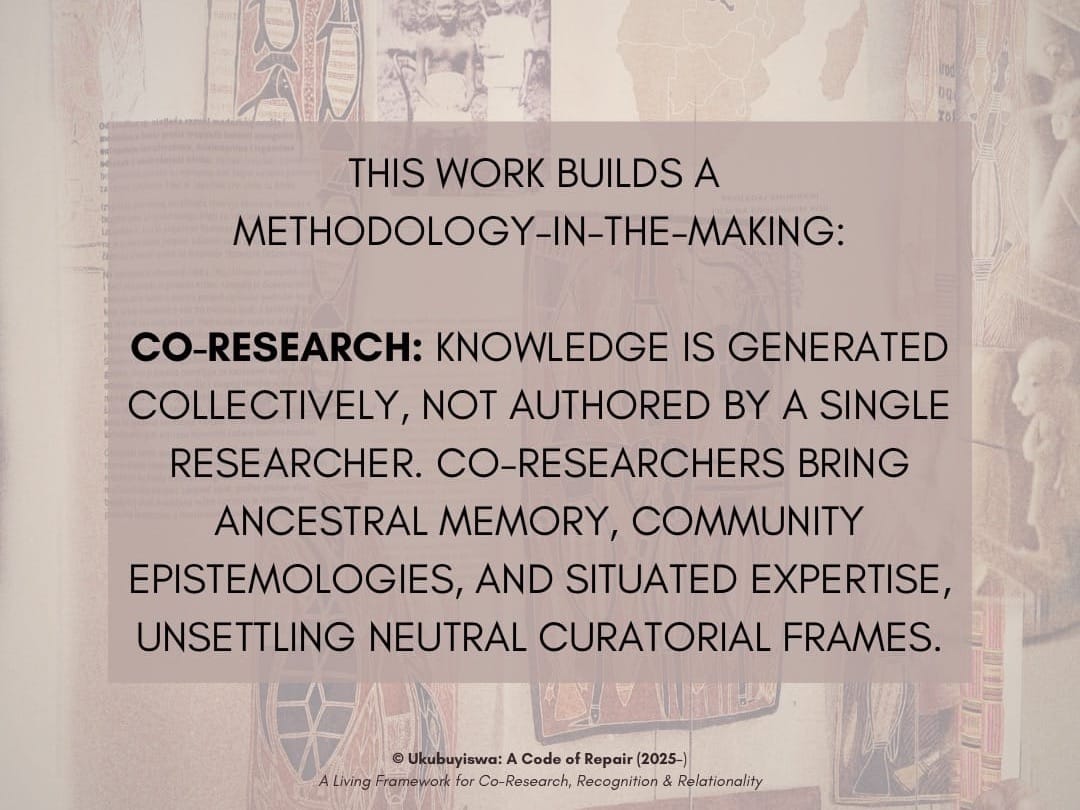
This project is grounded in co-research, not as a collaborative gesture, but as a redistribution of power, labour, and obligation. We did not add voices to an exhibition; we assembled relations for a return. Each co-researcher enters with a distinct capacity - access, language, ritual competence, institutional literacy, lived memory - and the work only moves when these capacities interlock. No single researcher carries the burden of interpretation alone. No singular voice stands in for the whole. Knowledge emerges through relation, not authorship.
To work in this way is not neutral. It asks something of those who enter. Co-research requires time, vulnerability, and an ability to sit with uncertainty. It requires attentiveness to the emotional and spiritual labour that restitution work demands - labour that is often rendered invisible by institutional timelines and output-driven frameworks.
Our questions are not procedural but ethical: who is invited in, what that invitation extends to, and how responsibility is shared once one enters the work. We are interested in historical accuracy and representation, yes - but more crucially, in an empathetic reading of what wishes to return. To listen clearly, the work must host multiple voices, and it must be able to pause when those voices diverge or withdraw.
In response to tensions that arise through and with this work, we develop the Code of Repair. It functions as a working compass rather than a fixed policy: a living, reflexive framework that helps orient the work when strain appears, when method falters, or when institutional demands threaten to override relational obligations. It is not a checklist of best practice. It is a safety net for moments of disagreement, exhaustion, overreach, and failure.
Consent, in this project, is not assumed by participation. It is continually renegotiated. Co-researchers retain the right to pause the work, to withhold knowledge, to revise earlier contributions, or to step away entirely. These gestures are not treated as failures of collaboration but as assertions of agency. Care, here, includes the right not to proceed.
We do not offer a total account of the past, nor do we claim to resolve the violences embedded in museum collections and archives. What we offer instead are windows—partial, situated perspectives that open onto other ways of reading, naming, and returning. The materials that emerge into public view are only slivers of a more complex field of relations, shaped by those who choose to enter and remain in conversation with the work.
This page does not invite participation. It names the conditions under which participation becomes possible. Those who enter do so with the understanding that the work moves at the speed of consent, pauses where care is incomplete, and remains accountable not only to institutions, but to the relations that make return meaningful at all.
Notes on terms and orientation:
a. On ukubuyisa and ukubuyiswa: We use both terms deliberately. ukubuyisa names the Xhosa ritual within the burial cycle in which a person is brought back into relation with the living, often months after the funeral. It continues ukukhapha (escorting, accompanying) and restores balance between the household and the one becoming an Ancestor. ukubuyiswa we use in two linked senses: (1) the instituted act of being returned, as an authorised process that makes return possible in the right way; and (2) our methodological frame for restitution understood as re-presencing: the ongoing work of bringing back relations (people, cultural belongings, knowledges) into right relation and care. In everyday isiXhosa, ukubuyiswa can also name anything fetched or brought back. We capitalise Ukubuyiswa when referring to the project.
b. “ngesilungu” is a relational marker. In everyday Xhosa it can mean “in the language/custom of the settlers/whites,” often colloquially “in English.” Here I use it more precisely to indicate the colonial register: the institutional idiom through which return is framed by museums, states, law, funders, and academia (in this context, museum-speak and policy language). So, “return ngesilungu” should be read as return narrated and governed within colonial/European institutional logics, rather than return grounded in isiXhosa ritual obligations and relational ethics. This is a structural description, not a comment on individual identity. Where clarity is needed, I offer orientation in footnotes rather than in-line brackets to preserve the timbre of the concepts.
c. On “Ancestors” in this archival project refers to ancestral presences and knowledges as they are carried in and through relations, places, and cultural belongings. This project does not address human remains. We use ancestral knowledge(s) when speaking about epistemic transmissions; we reserve Ancestors for presences/relations that exceed the purely informational.
d. On ukukhapha: Ukukhapha refers to the ritual process of accompanying the deceased, guiding them through transitions that establish right relation between the living and the one becoming Ancestor. Within isiXhosa theology, ukukhapha establishes the sequence within which subsequent rites must occur. Ukubuyisa does not replace ukukhapha; it continues it—particularly where time, disruption, or institutional interruption has intervened.
e. On delay as ethical interval: In this project, delay is not treated as administrative failure or lack of will. It is understood as an ethical interval that allows for consultation, consent, and ritual accountability—particularly where knowledge is unevenly held or authority has been displaced.